Guides
Computed, explained, verifiable.
Practical articles on design of experiments, prediction models, docking, biologics and formulation. Every number comes from a calculation you can follow yourself.
Guide
Response Surface Methodology, End to End
A response surface methodology tutorial with a worked example: 18-run CCD, quadratic fit R2 0.9988, optimum with CIs, design space and residual.
Read articleUse case
High Concentration Antibody Viscosity: Predict It Early
High concentration antibody viscosity decides whether your mAb can be a subcutaneous injection. Predict it from sequence before formulation work begins.
Read articleExplainer
pLDDT Explained: When to Trust a Predicted Structure
pLDDT interpretation for practitioners: what the bands mean, why a global mean hides the region you care about, and real numbers on MSA depth.
Read articleGuide
ADC Design: DAR, Linker and Payload Liabilities
ADC design from sequence: DAR distribution, conjugation site counts, linker stability and the hydrophobicity/aggregation trade-off, with real data.
Read articleUse case
QbD Process Development: Screen, RSM, Regression Model in One Run
A QbD process development workflow end to end: DoE screen, response surface, regression on one 29-run Pd coupling, with every number really calculated.
Read articleExplainer
Docking Score Interpretation: What −10 kcal/mol Means
Docking score interpretation, honestly: what a −10 kcal/mol docking score does and does not tell you, using a real docking run on KRAS G12C.
Read articleUse case
LNP Formulation Optimization for mRNA
LNP formulation optimization for mRNA with real results: MC3 baseline 86.3% EE, 94.9 nm, PDI 0.150, and a Pareto front reaching 88.0%.
Read articleUse case
Ionizable Lipid Screening Straight From SMILES
Ionizable lipid screening without burning stock: rank custom lipids from SMILES, pick the most informative next run, and see the real size trade-off.
Read articleExplainer
Split-Plot Designs for Hard-to-Change Factors
A split plot design DoE with real results: whole-plot vs sub-plot structure, why full randomisation fails in a reactor, and how to analyse it correctly.
Read articleExplainer
Definitive Screening Design: A Real 13-Run Example
What a definitive screening design is, shown with a real 13-run DSD for 6 factors, plus power numbers and the interaction aliasing.
Read articleComparison
Co-Folding vs Docking: Which Question Are You Asking?
Cofolding vs docking: what ipTM and a docking score each actually measure, with real ipTM 0.99 and −10.35 kcal/mol on KRAS G12C.
Read articleUse case
Antibody Developability Prediction From Sequence
Antibody developability prediction from sequence alone: an assessment of trastuzumab re-finds its documented CDR and Fc liabilities before wet-lab.
Read articleGuide
Augment a Screening DoE into a Response Surface
How to augment a DoE design to an RSM: turn a 13-run screening design into a 21-run CCD with 8 new runs instead of starting over with 17.
Read articleUse case
Generative Molecule Design That Survives ADMET
Generative molecule design is easy; ADMET filtering is the hard part. A real designed analogue run through tox screening and docking, with in-domain flags.
Read articleBenchmark
Solubility Prediction Model Accuracy: How to Read It
Solubility prediction model accuracy explained: scaffold vs random splits, RMSE 0.689 on 4,193 held-out rows, and why apparent is not intrinsic solubility.
Read articleExplainer
Mixture Designs for Formulation DoE
Mixture design formulation DoE explained: why components summing to 1 break factorial designs, what L-pseudocomponents do, and worked simplex designs.
Read articleGuide
DoE Power Analysis Before You Run the Experiment
DoE power analysis in plain terms: why a 13-run screening design catches a 1 sigma effect 82% of the time but a 0.5 sigma effect only 31%, and how factor.
Read articleUse case
Antisolvent Crystallization Design: Pick the Route First
Antisolvent crystallization design in practice: how to choose antisolvent vs cooling, set the volume fraction, and predict yield before you touch.
Read articleComparison
Cooling vs Antisolvent: Choosing the Isolation Route
Cooling vs antisolvent crystallization: how supersaturation is generated, when cooling simply cannot work, and a worked example: 0.0% vs 99.96%.
Read articleExplainer
Applicability Domain in QSAR: When a Model Says I Don't Know
What the applicability domain in QSAR is, how Tanimoto, feature range and leverage methods define it, and why out-of-domain predictions must be downgraded.
Read articleUse case
Green Solvent Substitution Without Losing Solubility
Green solvent replacement in pharma: rank ICH Q3C Class 3 alternatives to DCM and chloroform by predicted solubility before you book lab time.
Read articleExplainer
Binding Site Druggability Prediction, Honestly Read
Binding site druggability prediction explained: how geometric pocket detection works, what the score means, and a real assessment of KRAS G12C.
Read articleComparison
Screening Designs Compared: Fractional, PB and DSD
Screening design comparison: fractional factorial vs Plackett-Burman vs definitive screening, with run counts, resolution and power from real calculations.
Read articleExplainer
DoE Residual Diagnostics: Shapiro-Wilk and Cook's D
DoE residual diagnostics explained: what Shapiro-Wilk, Cook's distance and leverage actually tell you about an RSM fit, on a real central composite design.
Read articleExplainer
Retention Time Prediction in HPLC Method Development
What retention time prediction in HPLC is actually good for, what it is not, and a worked impurity panel with real predictions.
Read articleUse case
Immunogenicity Prediction for Antibodies: MHC-II Screening
Immunogenicity prediction for antibodies: how MHC-II epitope screening works, real results on trastuzumab VH/VL, and what in-silico ADA risk cannot.
Read articleComparison
Central Composite vs Box-Behnken: Which Design, When
Central composite vs Box-Behnken on the same 3 factors: real run counts, axial points, power and the corners each design does not visit.
Read article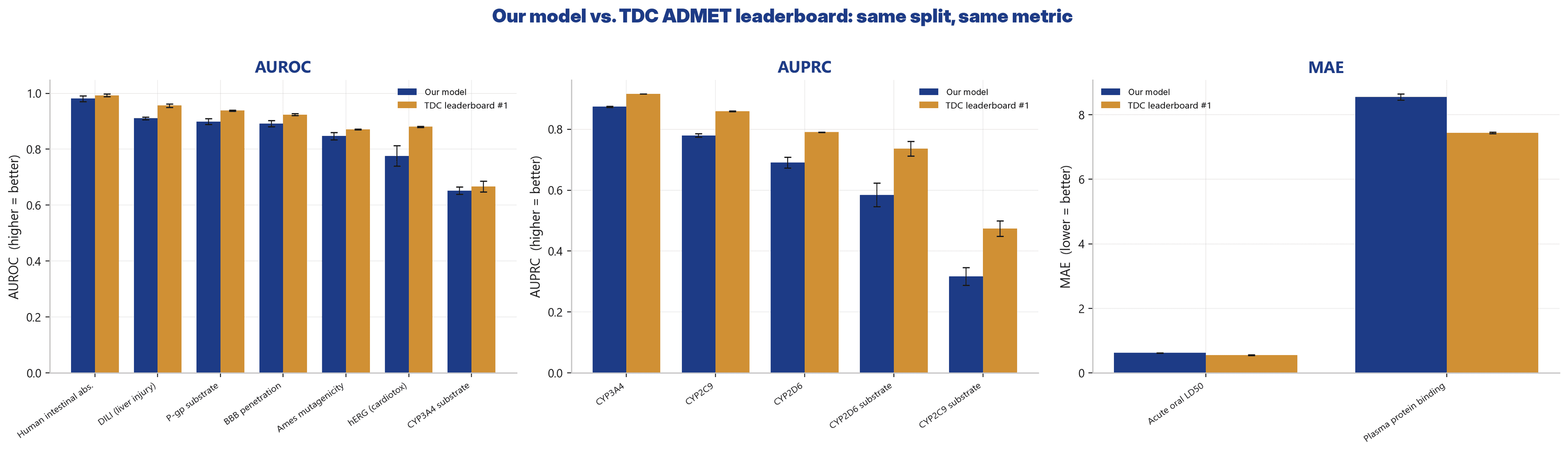
Benchmark
Can toxicity be predicted? The toxicity benchmark, measured honestly
Our toxicity prediction covers the common ADMET and toxicity endpoints. In a direct comparison against the TDC leaderboard, we sit a few points below the best dataset-specialized models on the AUROC endpoints. We name the weak spots openly.
Read article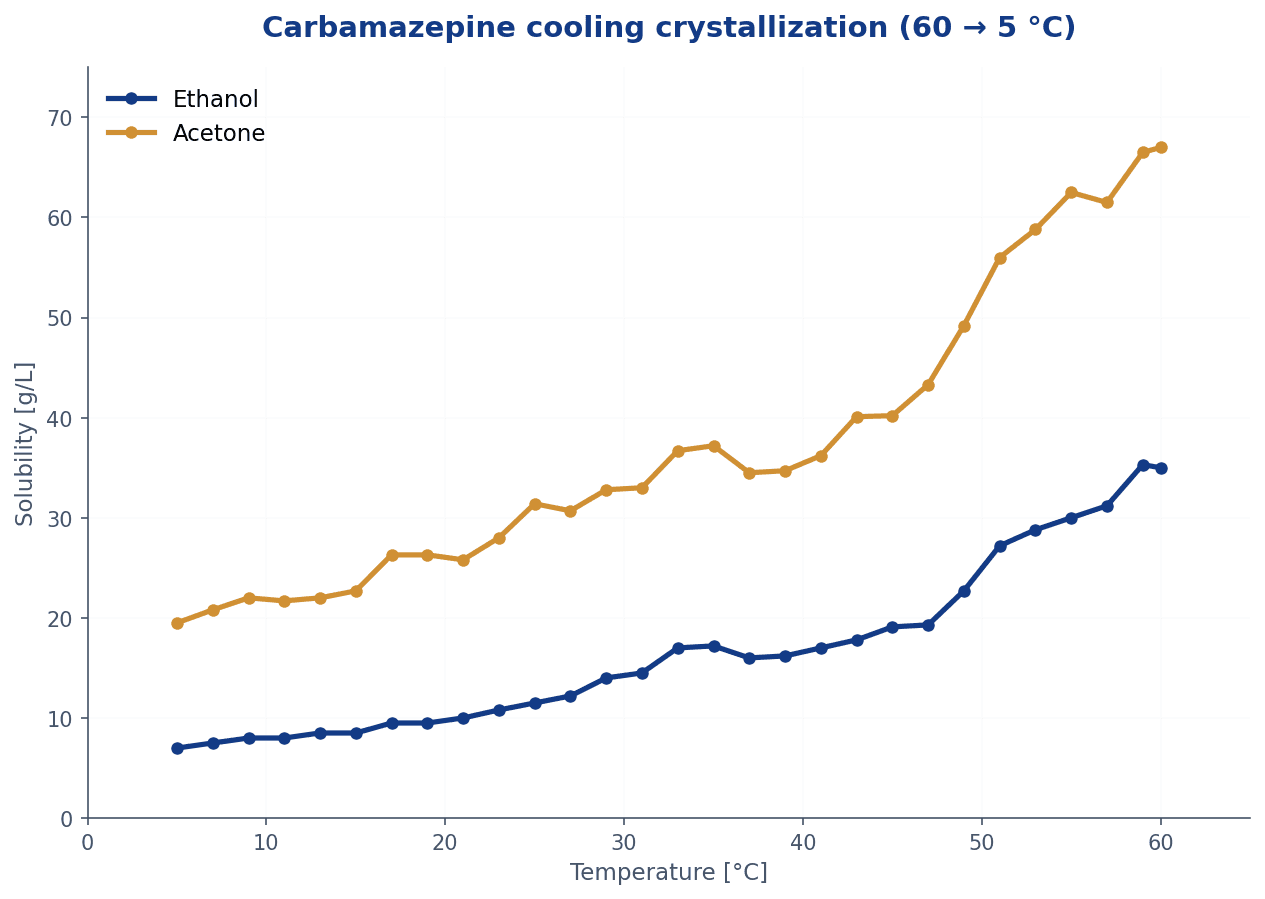
Use case
Designing carbamazepine crystallization, three steps with solubility prediction
Solvent screening, cooling curve, anti-solvent. Why acetone dissolves more at both temperatures but ethanol gives the higher yield, and how water as an anti-solvent crashes solubility by a factor of 220 without cooling a single degree.
Read article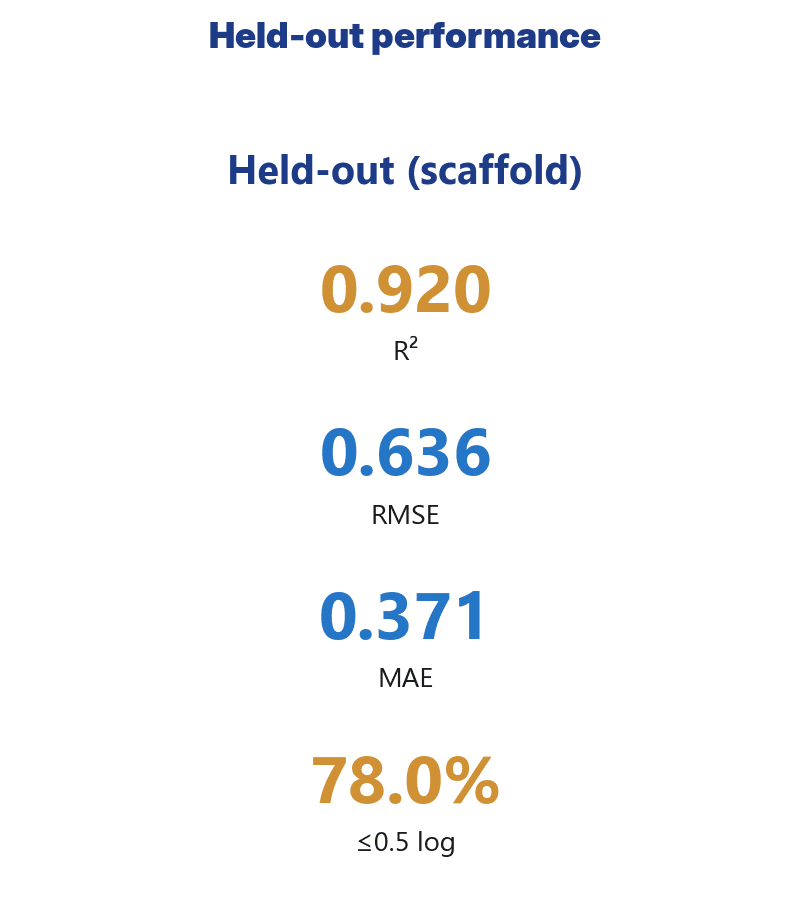
Benchmark
Solubility prediction benchmarked: predicting solubility at R² 0.92, and why the honest number is the more important one
Our solubility model predicts logS at R² 0.92 and RMSE 0.64, on 5,315 unseen molecular scaffolds. 78% of predictions sit within 0.5 log units of the measured value. How close that is to the physical noise floor, honestly explained.
Read article


